Showing posts with label Suburb - Acton. Show all posts

Friday, May 1, 2015

Hotel Hotel - on the inside


Love the use of timber on this staircase in Hotel Hotel, NewActon.

Thursday, April 30, 2015

Hotel Hotel


Hotel Hotel at NewActon Nishi. It's been open for a while, but I hadn't been there until recently when I won movie tickets to the theatre within the building (and what a fabulous theatre complex it is!).

Wednesday, January 18, 2012

ANU entrance


Entrance to the Australian National University, off Barry Drive.

Monday, September 12, 2011

The Street


The Street Theatre - next to the ANU, and across the road from the NAB building in yesterday's photo.

The theatre was purpose-built by the ACT government, and opened in 1994. The complex includes two theatres, meeting rooms and a cafe/bar, and operates as a venue for a variety of performance types, including music, drama, cabaret and dance. The larger theatre (Street1) can hold an audience of 247, while Street 2 is a more intimate space, with room for 65-80 people, depending on the audience set up.

The angled front entrance to the theatre was inspired by the 'desire line' (what I would call a 'goat track'!) created by people entering the university, and cutting across the corner of the then vacant black of land.

Sunday, September 11, 2011

Banking on Childers St


The National Australia Bank building on the corner of University Avenue and Childers Street.

Wednesday, September 7, 2011

School of Art


At the end of Childers Street is the Art Deco inspired School of Art building. Opened in 1939 as Canberra's first purpose built secondary school, it operated as Canberra High School until 1968, when declining enrolment numbers and a lack of facilities resulted in the school moving to the Belconnen suburb of Macquarie.

Between 1968 and1976, the building had various uses, including as the Canberra Technical College Art School, Canberra Technical College Biological Science Centre (its proximity to the old Institute of Anatomy), as premises for the ACT Apprentices Board, the ACT School Authority Teaching Resources Centre, the ACT Scholarships Office and the Australian Pre-School Association.

In 1976, the Canberra School of Art separated from the Canberra Technical College, and took over the site from other tenants. In 1988 the School of Art and the Canberra School of Music (which has its own premises) amalgamated to form the Canberra Institute of the Arts, and they the first affiliated and in 1992 became part of the university to become the ANU Institute of the Arts. It's now called the ANU School of Art, and is part of the ANU College of Arts and Social Sciences.

Click on the photo to see a larger version, and the clock tower above the main doors. Soon the trees will be in full leaf again and you won't be able to see the clock from this position.

Tuesday, September 6, 2011

Colour!


In contrast to yesterday's black and white image (and and unlike this afternoon's grey and damp weather), today I have something bright and colourful for you.

These light sculptures and coloured awnings extend along 200 metres of Childers Street, adjacent to the ANU and part of Canberra's 'arts precinct'. In fact, I think the main reason for them is to say 'Hey! Here's something arty! You must be in the arts precinct!', because otherwise it's not particularly obvious. But I like them anyway.

Designed by Thylacine (based in Queanbeyan; '... a collaborative, flexible and fluid organisation, drawing on visual and fine arts, craftsmanship, research, engineering, fabrication and project management in their practice.  Recent and current projects show their output is a body of uncommon iconic works, bringing sound, light, thought and memory together and delivering powerful built works'. AILA), the work is described as:
A large-scale interactive light installation spanning the length of Childers Street. The artwork consists of a series of 19 illuminated shelter structures clad in coloured glass. Sensors on each structure pick up loacalised sounds, transforming them into moving light patterns on vertically suspended coloured glass panels. The patterns are derived from a 'Synaesthetic' system that maps sound into colour, developed by the composer Alexander Scriabin.
For photos of the work at night, go to www.thylacine.com.au, click on Art Projects, and then the thumbnail picture on the bottom left.

Monday, September 5, 2011

Spout

Spout [Mark Grey-Smith. 1988. Ferro cement. Acquired 1998. (Crisp Building grounds)]

Not quite finished with the ANU water feature of the past few days ... As well as the peaceful reflecting pond, and the mossy walls with the small splashing fountains, there's this cement sculpture.

From the ANU Sculpture on Acton Campus brochure:

Mark Grey-Smith graduated in sculpture from the Chelsea School of Art, London and completed postgraduate studies at the ANU School of Art, where he later taught sculpture.
Appropriately for a fountain, the arch form of this sculpture looks like a fossilised spout of water with its splash. Grey-Smith makes honest use of that extremely versatile construction medium, reinforced concrete. This is seen in the way he allows the metal rib structure to show through the sinuous organic arches and the opening and closing forms sprouting at their base.

Mark Grey-Smith was born in Perth, Western Australia, in 1950, and has two other sculptures on the ANU campus.

Sunday, September 4, 2011

Saturday, September 3, 2011

Quiet reflections


Behind the Haydon-Allen building at the ANU, in a courtyard surrounded by that and other buildings, is a quiet pool, reflecting the nearby trees and the blue sky and sunshine at this turn of the seasons.

Friday, September 2, 2011

Relic

Relic [2006. Rick Amor. Bronze, corten steel base]

Relic is a two metre tall sculpture of a figure reminiscent of the Egyptian Anubis, although the sculptor, Rick Amor, has said that's not what it is: 'It's a relic, it's a distant memory. I don't know where it came from, from the unconscious. It's not meant to be an Anubis or any Egyptian deity, it's just something that popped up.' (The Age).

Rick Amor was born in Frankston, Victoria, in 1948, and has been exhibiting his paintings for nearly 40 years. He starting sculpting in the 1990s, and in 2007 won the $100,000 McClelland Sculpture Award for this piece.

It now sits at the intersection of Childers Street and University Avenue, with its back to the university and facing City Hill. And no, that's not a beer bottle on its shoulder - it's the top of the flagpole at the law courts in the background.

Thursday, September 1, 2011

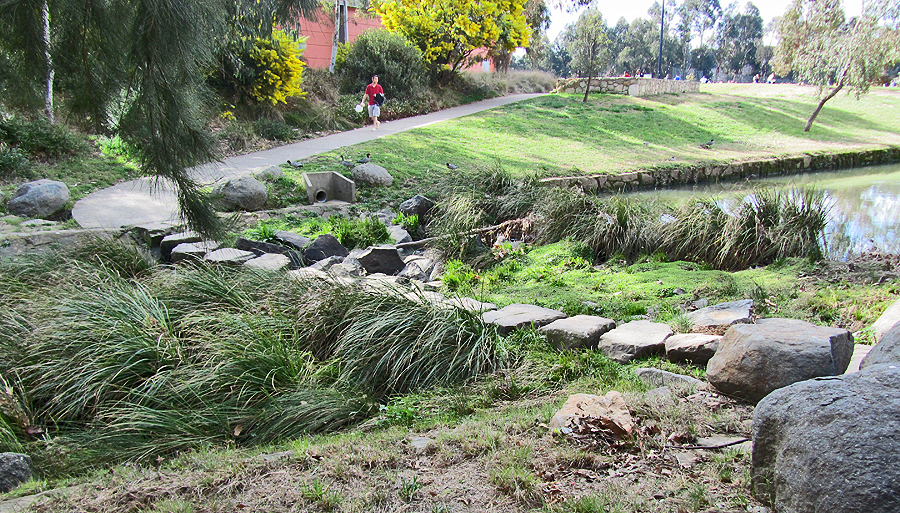
Sullivans Creek


This is Sullivans Creek, which runs through the ANU campus, and which I talked a little about yesterday. This photo is looking towards Barry Drive, to the east, and you can see some of the willows which helped give Toad Hall its name.

A little further to the west, there's a narrowing of the creek, and stepping stones to cross it:


Further along, it becomes little more than a stormwater drain, albeit one that can carry a lot more water when it rains than is shown here:


Wednesday, August 31, 2011

Frog


Found above the street gutter drains at the ANU campus.

Sullivans Creek runs through the middle of the university grounds, and the willow trees lining it in parts are the reason one of the residential buildings was given the name Toad Hall (in reference to The Wind in the Willows).

Originally named Canberry Creek, and flowing into the Molonglo River (part of which became Lake Burley Griffin, where the creek now empties), its name was changed to Sullivans Creek after the Sullivan family, who owned much of the surrounding land in the late 19th and early 20th century. Parts of the creek are now sealed, and carry stormwater from the urban area out to the lake.

Tuesday, August 30, 2011

Speaking Australian


Hands up who knew there was such a thing as the Australian National Dictionary Centre? I certainly didn't, but here it is, located on the ANU campus.

According to their website:
The Australian National Dictionary Centre conducts research into Australian English, and provides Oxford University Press with editorial expertise for their Australian dictionaries. It was established in 1988, and is jointly funded by The Australian National University and Oxford University Press Australia.

If you're new to Australian English, you night like to check out Aussie English for Beginners - you'd have to be a stubby short of a six-pack not to!

Monday, August 29, 2011

Open Day


More from the ANU Open Day on Saturday. Gorgeous weather, the pink and white blossoms of ornamental cherries and plums, music, food and plenty to see and do! This is the main student services area, with the student union, food outlets, a pharmacy and plenty more.

Sunday, August 28, 2011

Beware the dragon


Yesterday was the annual Tertiary Open Day, when Canberra's five big tertiary institutions hold their coordinated open days. This year I happened to be at the Australian National University, and spotted this fellow when wandering around after my seminar. I did some searching online today, and discovered that the dragon is the mascot of Bruce Hall, one of the student residences on campus, and when I zoomed in on the logo on his friend's shirt, it confirmed that they were promoting the Hall to prospective students.

Tuesday, July 19, 2011

Facing the flag


Looking from the end of Acton Peninsula across Lake Burley Griffin and Lennox Gardens to Parliament House. Before the man-made lake was filled, this area was a dairy farm and then a golf course, and a yacht club was based there later. It's now a public park, with barbecue and picnic facilities.

Monday, July 18, 2011

Darter


This is an Australasian Darter, commonly seen drying themselves off on the banks of Canberra's lakes, even on days when the temperatures don't make it into double figures. This one decided to go fishing soon after I took the photo, completely disappearing beneath the choppy waters as it looked for fish. They often float in the water with their bodies submerged and just their long, snakelike necks above the surface.

Sunday, July 17, 2011

Catching the breeze


The National Museum of Australia extends over three levels. I took this photo from the top level - the Australian Journeys gallery - looking down into the children's area between the Old New Land  and Landmarks galleries on the ground floor, and further to the other part of the Landmarks gallery on the lower ground floor. The brightly coloured cupboards hide surprises for kids, and there's an activity booklet to go with them. There are also short red pillars with things for kids to look for in each area of the museum - a great way to keep them engaged and really looking at objects they might otherwise dismiss as just 'old stuff'.

That's a full-size windmill you can see. Obviously it's not set on the high tower familiar to anyone who's travelled through country areas in Australia, and it's quite impressive to see one up this close. This one has 24 blades - they can range from 11 to 36. The more blades, the slower the wheel will turn, but the less wind is required to get it started. It's 6 metres across, was made in the 1920s, and came from Kenya Station in Queensland. There's more information on this particular windmill on the museum's website.

Saturday, July 16, 2011

One more from the garden


One more image from the Garden of Australian Dreams. This photo is taken from somewhere near Darwin in the Northern Territory. You see, the ground of the Garden is a giant map, or rather a number of maps superimposed. It's a strip of Australia, running down from the Tiwi Islands (behind me) and down past Birdsville (over the other side of the hill). As well as place names and the names of Aboriginal tribal areas, there are survey marks, roads, rivers and vegetation types. And across the whole thing, there is the word 'home' in many of the languages spoken in multicultural Australia.

There's more symbolism here, but I think tomorrow we'll go inside.