Monday, June 20, 2011

Around in Fisher


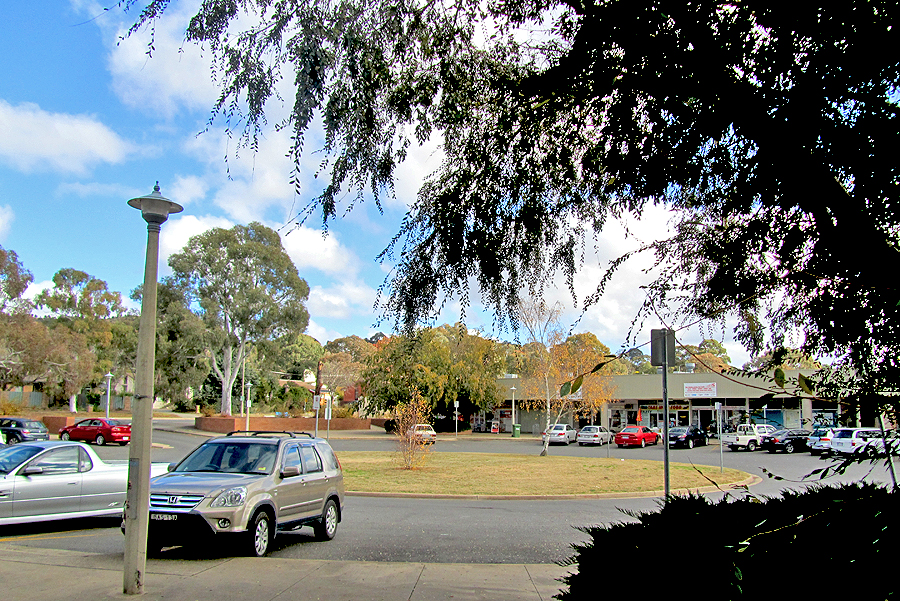
Fisher is a suburb in the Weston Creek district. It's named for Andrew Fisher, who was a Scottish coal miner, staunch unionist, and became Prime Minister of Australia for three terms between 1908 and 1915.

The circular carpark is quite unusual for a local shopping centre - this is the only one I've seen in my travels. The suburb was one of the first to be developed in Weston Creek, in 1968, and it's currently home to about 3000 residents.

Sunday, June 19, 2011

The Melbourne Building


PJ O'Reilly's is an Irish pub on Alinga Street, Civic. It's been there since 1999, and is a popular venue for after-work drinks and functions.

The pub is housed in part of the Melbourne Building. Because I've had a really busy weekend and I'm exhausted, I'm just going to quote from Wikipedia on this building (and the matching Sydney Building):

The Melbourne and Sydney buildings were based on design principles set by John Sulman in sketch form. The design work was finalised by J H Kirkpatrick. The buildings were the model which establish the colonnade principle, an important design element throughout Civic. From 1921 to 1924 Sulman was chairman of the Federal Capital Advisory Committee, and in that role was involved in the planning of Canberra and refining Griffin's plan.

Sulman's concept of arcaded loggias was derived from Brunelleschi's Ospedale degli Innocenti (Foundling Hospital) and the cloisters of the 15th century Basilica di San Lorenzo di Firenze. The Mediterranean influence was maintained by Kirkpatrick with Roman roof tiles and cast embellishments such as roundels. The buildings were originally constructed with open first floor verandahs which have since largely been glazed in.

The Melbourne Building was sold sequentially as independent parcels from 1927 until 1946. The corner of West Row and London Circuit was built specifically for the Bank of New South Wales (now the Westpac Banking Corporation). The manager lived above the bank. Much of the Melbourne Building facing West Row was completed by the Commonwealth Government in 1946 and used as the location of the Commonwealth Employment Service. From 1944 to 1953, the Canberra University College was housed in the Melbourne building. On 11 April 1953 the Melbourne Building was severely damaged by fire and the college relocated (it eventually became the Australian National University).

Saturday, June 18, 2011

Very big for a little man

The Big Little Man [Dean Bowen, 1999]

This bronze sculpture, The Big Little Man, stands in Petrie Plaza in Civic. He's like a child's drawing, expanded into three dimensions and about two metres tall.

Dean Bowen is a Melbourne artist, who paints, draws and prints as well as sculpting. He has a number of these whimsical sculptures in various places, including The Farmer in Shepparton, Victoria, and Aeroplane Boy in Melbourne.

This is what the artist had to say about The Big Little Man:
This sculpture (“The Big Little Man”) was based on a small bronze maquette, which weighed about 7 kilos. This sculpture weighs approximately 400 kilograms. Originally made in clay and then cast in bronze using the lost wax method of casting.

I think of his face as a giant section of the earth and the planet, the undulations where it goes up and down like the earth; the holes in the sculpture are like caves or hills, mountains and valleys; the large hat is apart from being a hat is also like a landscape with two huge hills like Mt St.Victoire in France ... 

This sculpture included originally making an armature of the piece – so with a large pole was put up through the center of the sculpture or where the sculpture would become, and other metal was welded around in an armature way, that was covered with chicken wire and inside the chicken wire was stuffed newspaper. Onto that armature clay was pushed into the chicken wire and gradually I made the sculpture by putting lots of clay onto the armature and gradually created the sculpture just with my hands.

When the sculpture was completed, a mould was taken and from the mould a wax was taken and using the lost wax method of casting liquid bronze was poured into the blank space. It was cast in two pieces, the head separately from the body and later on the two pieces welded together with rods that go through the head and the torso.

Then the sculpture was chased, where all the little rough bits of bronze were ground away, chiseled off, sanded, just generally cleaned-up which is a massive job. And finally the patina was put on to the sculpture where the sculpture is heated with a blow torch and with different chemical compounds painted directly onto the bronze. With the patina finished the sculpture is finally waxed, and the wax painted over the bronze protects the bronze so it can be outdoors for several years.

Friday, June 17, 2011

Coin collecting


I don't think I've ever actually seen someone collecting the parking meter money before this. He was on Ainslie Avenue in Civic, walking around with his heavy metal cylinder on a trolley, opening the meters and removing the coins. No security apart from his radio, but I guess you'd have to be a pretty keen thief to take a load of heavy coins, and then try to break into the cylinder! I hope the owner of the car behind him wasn't too far away - his meter has expired and the parking police are often around.

Thursday, June 16, 2011

Feeling a little yellow


Spotted this little fellow on the footpath outside Tosolini's on London Circuit in the city yesterday. Little things like this make me smile :)

Wednesday, June 15, 2011

On the buses


I don't catch buses very often, but today I needed to go into the city for a meeting, and The Husband required the car, so a bus it was.

Public transport in Canberra is provided by ACTION - the ACT Internal Omnibus Network. Modern buses, like this one, have easy access - there's just the one step onto the bus for normal use, an extendable ramp, and the whole bus can tilt over slightly towards the door to minimise the step height from ground level. Some buses (like this one) are powered by compressed natural gas. If you're into the mechanics, there's a spec sheet for this bus available on the ACTION website. The bus system is quite good, although it takes quite a lot longer for a journey than it does by car as the buses wind through the suburbs.

The yellow structure on the front is a double bike rack, and someone got on with a bike during the journey, so I was able to get a photo of it in use:
Tuesday, June 14, 2011

Daytime moon


The moon has been very visible in the afternoon sky recently. This photo was taken on Saturday, at about 3.30pm.

Monday, June 13, 2011

The Bush Capital


This photo was taken on Saturday from the water reservoir hill in Spence, near the top of Copland Drive. That's Black Mountain, with the tall telecommunications tower on its summit, and in between are the suburbs of Evatt, McKellar and Bruce. Roughly 12,000 people live in those three suburbs, although it's a bit difficult to imagine that from this angle - you can certainly see why Canberra is called the 'Bush Capital'!

Sunday, June 12, 2011

Peek-a-boo!


I glimpsed a flash of bright red in a eucalypt while out for a walk yesterday, and eventually spotted this fellow and his mate in amongst the leaves. They were very good at keeping mostly out of sight, and this is the best photo I could get. He's a Crimson Rosella, similar to the King Parrot, but the blue cheeks are the giveaway.

Saturday, June 11, 2011

Not just on Sundays


I walked home from school with the kids yesterday, and on the way we passed North Belconnen Baptist Church, in Chomley Court, Evatt. Many of the churches in Canberra are of fairly recent design, and often they fulfil several functions. As well as church services, they might act as community halls, host playgroups, or be the venue for creative or discussion groups.